A learning-research-service-social close-loop for scholars
Many people see scholars as enjoying an enviable lifestyle: relatively free schedules, seemingly self-directed agendas, unconstrained by the fixed working hours, explicit KPIs, or constant external supervision that characterize many other professions. To a degree, this perception is not wrong. Academic workers—especially PhD students, postdocs, and university faculty—do tend to have greater autonomy. And precisely because of this, there is an analogy I have always found remarkably fitting: a scholar is essentially their own CEO.
This metaphor is apt because scholars are, in essence, running a small enterprise centered on themselves. They must decide their own research directions, allocate their own time, screen their own opportunities, and bear the consequences of their own choices. What the outside world grants them is freedom—but freedom has never been synonymous with ease. It is more like a higher-order responsibility: you may not be tightly managed, but you must be accountable for the final output; you may live at your own pace, but you must pay the price for your own stagnation.
In an era where AI is rapidly reshaping the way knowledge is produced, this capacity for “self-management” has become more important than ever. Information updates faster, technology iterates more frequently, and academic competition has become increasingly global. For today’s scholars, simply “burying oneself in research” is no longer enough. A truly efficient, sustainable, and high-potential academic life often requires synergy across multiple dimensions, forming a steadily running closed-loop system.
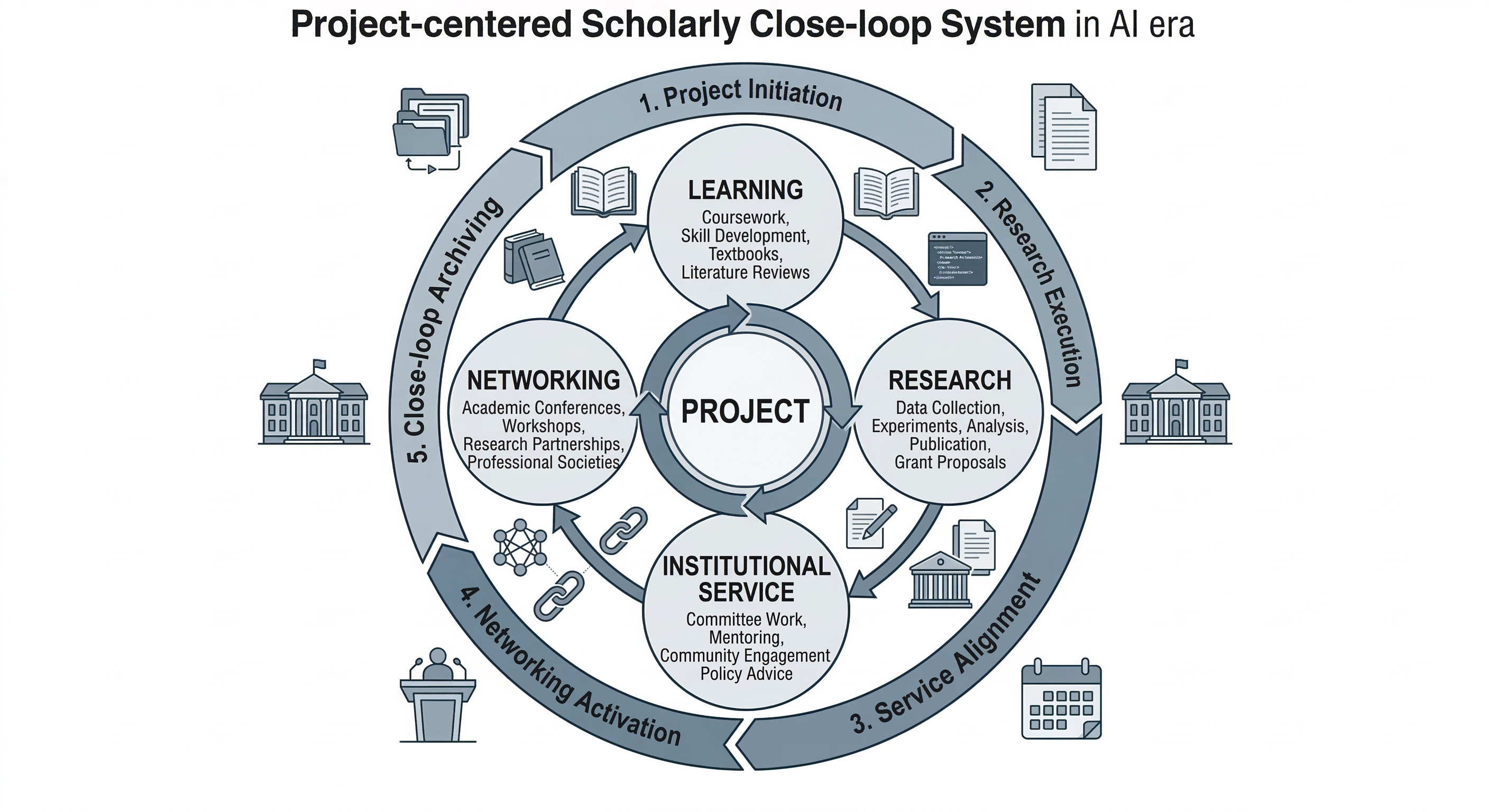
I have come to believe that what matters most for a scholar is not just hard work, but building a learning–research–service–social close-loop organized around academic projects.
1. Learning Is the Input of Research
Scholars must, first and foremost, keep learning.
Learning is not merely about “knowing more”—it is about continuously updating your ability to understand the world, pose questions, and solve problems. Today, what one learns extends far beyond classic literature and theoretical frameworks; it also encompasses new computational methods, new technical tools, new data resources, and the fresh perspectives that emerge from the ever-growing convergence of disciplines.
This has become especially clear in the AI era. In the past, a researcher might only need to follow core papers in their own field. Now, breakthroughs often come from crossing boundaries—from machine learning, causal inference, remote sensing, GIScience, cognitive science, or some newly emerging capability of large models. Whoever absorbs these changes faster gains a new research leverage.
Therefore, learning is not an accessory to research; it is the most important source of raw material for research. Without continuous learning, research easily falls into repetitive labor; without knowledge renewal, researchers gradually lose the ability to ask good questions.
2. Research Is the Scholar’s True Product
If learning is the input, then research is the output.
A scholar can attend many events and master vast knowledge, but the ultimate measure of their academic value remains whether they have produced work that is genuinely contributive, explanatory, and influential. Papers, methods, datasets, systems, theoretical frameworks, policy recommendations—these are all different manifestations of research, but at their core, they collectively constitute the “product” that a scholar delivers to the academic community and society.
Research, therefore, cannot merely “look busy.” It must point toward a well-defined problem, a clear innovation, and a verifiable contribution. Much of the exhaustion in academic life comes not from having too much to do, but from too many activities failing to crystallize into real research outcomes. Being busy learning without forming research questions, busy networking without converting connections into collaborative results, busy with administrative tasks without protecting research time—all of this leads to a state of low-output attrition.
From this perspective, one of a scholar’s core competencies is to continually funnel the various inputs of life back into research. Research is not just one module of academic life—it should be the center of the entire system.
3. Institutional Service Is the Infrastructure of the Academic System
Many people overlook the importance of institutional duties, viewing teaching, administration, meetings, grant applications, and student supervision as mere “chores” outside of research. But from a more pragmatic standpoint, institutional service actually forms the infrastructure that sustains academic life.
Scholars do not exist in isolation from institutions; they work within universities, colleges, research centers, and labs. Teaching responsibilities, administrative work, project management, and student mentoring consume time, yet they also provide identity, resources, and a platform. They are both obligations and an integral part of the academic career.
The issue is not whether these duties exist, but whether they erode the central place of research. Excellent scholars are rarely free of duties altogether—rather, they manage to fulfill necessary responsibilities while preventing those duties from consuming their creativity. They know which tasks demand care, which need swift handling, and which are not worth excessive investment.
The key to institutional service, then, is not just “getting things done” but managing boundaries. You should contribute to the organization, but also protect your core research agenda from being shattered by trivia.
4. Networking Is the Lever That Amplifies Research Opportunities
Beyond learning, research, and service, networking is an indispensable part of academic life.
The networking I refer to here is not superficial small talk, nor the mechanical expansion of one’s contact list to “know more people.” It means high-quality connections built around research topics, academic opportunities, and long-term collaboration. The kinds of collaborators a scholar can access, the project networks they can join, the funding opportunities they learn about, and the platforms they participate in are all closely tied to their networking ability.
Academia is not a world where work circulates automatically on merit alone. Good research is of course important, but making good research visible, understood, collaboratively extended, and built upon is equally important. Many collaborative opportunities, resource opportunities, and even career opportunities do not arise purely from open competition—they come from trust, visibility, and shared interests cultivated over time.
In today’s academic environment especially, interdisciplinary collaboration, international partnerships, and university–industry cooperation are increasingly vital. Whoever can embed their research within a larger network will find it easier to secure a broader research space.
So, networking is not the antithesis of research—it is research’s amplifier. The prerequisite is that such networking must revolve around one’s academic agenda, rather than being squandered on meaningless socializing.
5. What Truly Matters Is Not Balancing Everything, but Forming a Close-Loop Around Projects
The reality is that time is finite.
No scholar can invest unlimited effort in every dimension. You cannot read extensively every day, write with sustained intensity, flawlessly handle all institutional duties, and frequently attend every social event. What truly matters is not mechanically pursuing an equal allocation across all four areas, but organizing them into a mutually reinforcing close-loop around a concrete academic project.
A good academic project should simultaneously drive learning, research, service, and networking:
- It tells you what to learn, rather than absorbing information aimlessly;
- It channels your learning into research outputs;
- It aligns the teaching or administrative work you take on with your research direction as much as possible;
- It gives your networking a sense of purpose, helping you find the people and opportunities that are genuinely relevant.
In other words, scholars are not balancing four disconnected modules—they are making all four dimensions serve the same core research agenda.
This is what the close-loop really means: Learning provides input, research completes the transformation, institutional service provides structural and resource support, networking brings opportunities and feedback—and all of these in turn drive the next round of higher-quality learning and research.
6. A Project-Centered Close-Loop Workflow
Having discussed principles, the real challenge is translating them into an executable workflow. Below is a close-loop workflow centered on a concrete research project.
Phase 1: Project Initiation — Deriving Questions from Learning
Every project should originate from the puzzles and insights accumulated during the learning phase:
- While reading literature, note the problems that “existing methods haven’t solved well”;
- While learning new technologies, consider whether they open a new research angle;
- While attending talks and exchanging ideas with peers, capture the recurring questions that still lack good answers.
These fragmented inputs will not turn into a project on their own. The critical action is periodic synthesis: every week or two, consolidate your scattered notes and ask yourself—what direction are these pointing toward? Is a sufficiently clear research question starting to emerge? When a question becomes specific enough and you can make a preliminary judgment about its novelty and feasibility, the embryo of a project has appeared.
Phase 2: Research Execution — Milestone-Driven Output
Once a project is launched, it enters the core research phase. The most common pitfall here is “always working, yet never producing a stage-gate result.” The antidote is milestone-driven execution:
- Decompose the project into 3–5 key checkpoints—for example: literature review complete → methodological framework set → core experiments done → first draft → submission and revision.
- Set a rough timeline for each checkpoint—not necessarily precise to the day, but with clear completion criteria.
- At each checkpoint, conduct a brief self-review: is progress on track? Does the direction need adjustment? Have new findings emerged that are worth incorporating?
Milestones are not a rigid schedule; they help you maintain direction and momentum within the “free-form” working state.
Phase 3: Service Alignment — Making Institutional Resources Serve the Project
While advancing a project, institutional duties should not simply be handled reactively—they can be proactively aligned with the project:
- If you have teaching responsibilities, try to choose or adjust course content so that it connects with your research direction;
- If you need to apply for funding or attend departmental meetings, frame the project as your core narrative—let it become the fulcrum for securing resources;
- If you have opportunities to supervise students, consider involving them in sub-topics of the project, fulfilling mentoring duties while also advancing the research.
The guiding principle: don’t interrupt the project for duties—weave duties into the project’s workflow.
Phase 4: Networking Activation — Connecting the Project to a Wider Network
The mid-to-late stages of a project are the optimal window for networking to take effect:
- Present interim results at conferences to gather peer feedback;
- Proactively reach out to researchers working on related topics to explore collaborations or data sharing;
- Publish results on preprint platforms, personal websites, or social media to increase visibility;
- After the project wraps up, carry the collaborative relationships and new discoveries into the learning phase of the next project, forming a positive cycle.
Phase 5: Close-Loop Archiving — Consolidating Experience, Launching the Next Round
After a project is completed—whether through publication, report submission, or a stage-gate conclusion—the most easily overlooked step is archiving and reflection:
- Which methods or tools from this project are worth reusing?
- What new questions emerged during the process that could seed the next project?
- Which people and connections made through networking are worth maintaining?
- What could be improved in terms of time allocation and pacing?
This reflection need not be lengthy, but it ensures that the experience from each project does not dissipate—instead, it feeds directly into the next round of learning and planning.
This is the complete close-loop: learning generates questions → research drives output → service provides support → networking amplifies impact → archiving consolidates experience → the next round of learning begins. Each project is not an isolated task but a vehicle for one full iteration of this system. When you treat every research project as an opportunity to run the loop once more, academic life ceases to be a pile of scattered duties and becomes a self-reinforcing growth engine.