学者的学习—研究—服务—社交闭环
A learning-research-service-social close-loop for scholars
How scholars arrange their academia life in an AI era
学者如何在 AI 时代安排学术生活

Core idea: learning → research (center) → service → social — a closed loop.
许多人认为学者享有令人艳羡的生活方式:日程相对自由、议程看似自主、不受固定工时、明确 KPI 或持续外部监督的约束。在某种程度上,这种印象并非谬误。学术工作者——尤其是博士生、博士后与高校教师——往往拥有更大的自主权。也正因为如此,我一直觉得有一个类比极为贴切:学者本质上就是自己的 CEO。
这一隐喻之所以成立,是因为学者实际上在经营一家以自身为核心的小型企业。他们必须自行决定研究方向、分配时间、筛选机会,并承担选择的后果。外界赋予他们的是自由——但自由从来不等同于轻松。它更像一种更高阶的责任:你可能不会被严密管理,但必须对最终产出负责;你可以按自己的节奏生活,但必须为自己的停滞付出代价。
在 AI 迅速重塑知识生产方式的时代,这种”自我管理”能力比以往任何时候都更加重要。信息更新更快、技术迭代更频繁,学术竞争日益全球化。对当今的学者而言,仅仅”埋头做研究”已不足够。一种真正高效、可持续、高潜力的学术生活,往往需要在多个维度上形成协同,构建一个稳定运转的闭环系统。
我逐渐认识到,对学者而言,最重要的不仅是努力,而是围绕学术项目构建学习—研究—服务—社交闭环。
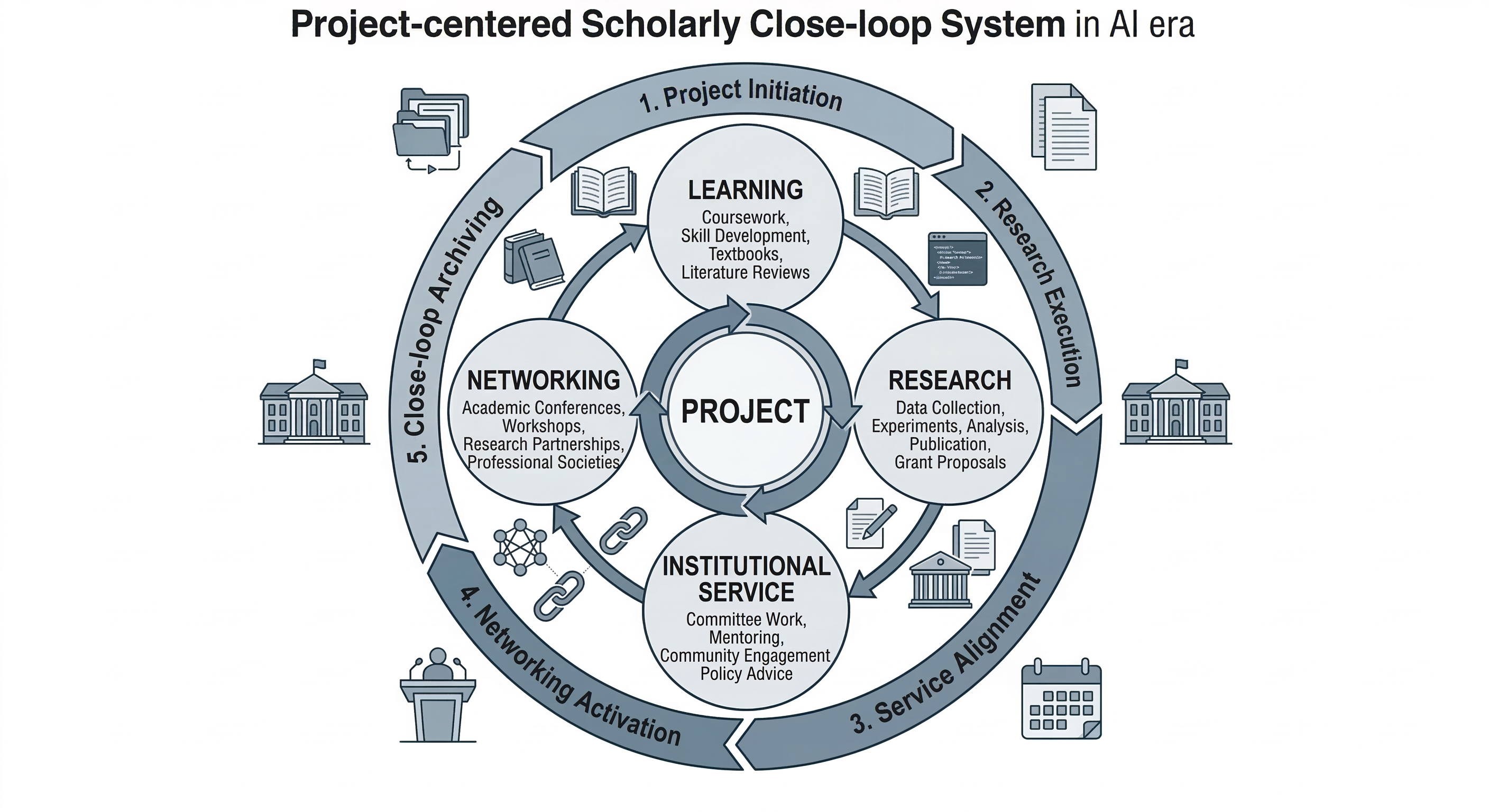
1. 学习是研究的输入
学者首先必须持续学习。
学习不仅是”知道更多”,更是不断更新理解世界、提出问题与解决问题的能力。今天,所学内容远不止经典文献与理论框架,还包括新的计算方法、新的技术工具、新的数据资源,以及学科交叉中不断涌现的新视角。
这在 AI 时代尤为明显。过去,研究者或许只需跟进本领域的核心论文;如今,突破往往来自跨界——机器学习、因果推断、遥感、GIS 科学、认知科学,或大模型的新能力。谁能更快吸收这些变化,谁就获得了新的研究杠杆。
因此,学习不是研究的附属品,而是研究最重要的原材料来源。 没有持续学习,研究容易陷入重复劳动;没有知识更新,研究者会逐渐失去提出好问题的能力。
2. 研究是学者的真正产品
若学习是输入,研究便是输出。
学者可以参加许多活动、掌握大量知识,但衡量其学术价值的最终标准,仍是是否产出了真正具有贡献性、解释力与影响力的工作。论文、方法、数据集、系统、理论框架、政策建议——这些都是研究的不同形态,但其核心共同构成学者向学术界与社会交付的”产品”。
因此,研究不能只是”看起来很忙”。它必须指向明确的问题、清晰的创新与可验证的贡献。学术生活中许多疲惫,并非因为事情太多,而是因为太多活动未能凝结为真正的研究成果。忙于学习却未形成研究问题、忙于社交却未将关系转化为合作成果、忙于行政却未保护研究时间——都会导致低产出的消耗状态。
从这个角度看,学者的核心能力之一,是将生活中的各种输入持续导回研究。研究不仅是学术生活的一个模块——它应成为整个系统的中心。
3. 机构服务是学术系统的基础设施
许多人忽视机构职责的重要性,将教学、行政、会议、基金申请与学生指导视为研究之外的”杂务”。但从更务实的角度看,机构服务实际上是支撑学术生活的基础设施。
学者并非脱离机构而存在;他们工作于大学、学院、研究中心与实验室。教学、行政、项目管理与学生指导消耗时间,但也提供身份、资源与平台。它们既是义务,也是学术生涯的有机组成部分。
问题不在于这些职责是否存在,而在于它们是否侵蚀研究的中心地位。优秀的学者很少完全没有职责——而是能在履行必要责任的同时,防止职责吞噬创造力。他们知道哪些任务需要用心、哪些需要快速处理、哪些不值得过度投入。
因此,机构服务的关键不仅是”把事情做完”,而是管理边界。 你应贡献于组织,也要保护核心研究议程不被琐事击碎。
4. 社交是放大研究机会的杠杆
除学习、研究与服务外,社交是学术生活中不可或缺的一环。
此处所说的社交,并非肤浅的寒暄,也不是机械地扩充通讯录以”认识更多人”。它指围绕研究主题、学术机会与长期合作建立的高质量联结。学者能接触到的合作者、能加入的项目网络、能获悉的资助机会以及能参与的平台,都与社交能力密切相关。
学术界并非一个仅凭实力自动流通工作的世界。好的研究当然重要,但让好的研究被看见、被理解、被合作延伸与被进一步建设,同样重要。许多合作机会、资源机会乃至职业机会,并非纯粹来自公开竞争——它们来自长期培养的信任、可见度与共同利益。
尤其在当今学术环境中,跨学科合作、国际伙伴关系与产学研合作日益关键。谁能将研究嵌入更大的网络,谁就越容易获得更广阔的研究空间。
因此,社交不是研究的对立面——它是研究的放大器。 前提是,这种社交必须围绕学术议程展开,而非浪费在无意义的应酬上。
5. 真正重要的不是平衡一切,而是围绕项目形成闭环
现实是,时间是有限的。
没有学者能在每个维度上无限投入。你不可能每天大量阅读、持续高强度写作、完美处理所有机构职责,又频繁参加每场社交活动。真正重要的不是机械地追求四者均等分配,而是将它们围绕具体学术项目组织成相互强化的闭环。
一个好的学术项目应同时驱动学习、研究、服务与社交:
- 它告诉你该学什么,而非漫无目的地吸收信息;
- 它将学习导向研究成果;
- 它尽可能使你所承担的教学或行政工作与研究方向对齐;
- 它赋予社交以目的,帮助你找到真正相关的人与机会。
换言之,学者并非在平衡四个割裂的模块——而是让四个维度服务于同一核心研究议程。
这就是闭环的真正含义:学习提供输入,研究完成转化,机构服务提供结构与资源支持,社交带来机会与反馈——而所有这些又驱动下一轮更高质量的学习与研究。
6. 以项目为中心的闭环工作流
谈完原则,真正的挑战在于将其转化为可执行的工作流。以下是以具体研究项目为中心的闭环工作流。
阶段一:项目启动——从学习中提炼问题
每个项目都应源于学习阶段积累的困惑与洞见:
- 阅读文献时,记录”现有方法尚未很好解决的问题”;
- 学习新技术时,思考它是否打开新的研究角度;
- 听报告、与同行交流时,捕捉仍缺乏好答案的反复出现的问题。
这些碎片化输入不会自动变成项目。关键动作是定期综合:每一两周,整合零散笔记并问自己——这些指向什么方向?是否已浮现足够清晰的研究问题?当问题足够具体、且你能对新颖性与可行性做出初步判断时,项目的雏形便已出现。
阶段二:研究执行——里程碑驱动产出
项目启动后进入核心研究阶段。此处最常见的陷阱是”一直在做,却始终没有阶段成果”。解药是里程碑驱动执行:
- 将项目分解为 3–5 个关键检查点——例如:文献综述完成 → 方法框架确定 → 核心实验完成 → 初稿 → 投稿与修改。
- 为每个检查点设定大致时间线——不必精确到天,但要有明确的完成标准。
- 在每个检查点进行简短自评:进度是否正常?方向是否需要调整?是否出现值得纳入的新发现?
里程碑不是僵化的日程;它帮助你在”自由形态”的工作状态中保持方向与动力。
阶段三:服务对齐——让机构资源服务项目
推进项目的同时,机构职责不应只是被动应付——可以主动与项目对齐:
- 若有教学任务,尽量选择或调整课程内容,使其与研究方向相连;
- 若需申请经费或参加系内会议,以项目为核心叙事——让它成为争取资源的支点;
- 若有指导学生机会,考虑将其纳入项目子课题,在履行指导职责的同时推进研究。
指导原则:不要因职责打断项目——将职责织入项目工作流。
阶段四:社交激活——将项目连接至更广网络
项目的中后期是社交发挥效用的最佳窗口:
- 在会议上展示阶段性成果,收集同行反馈;
- 主动联络相关方向研究者,探索合作或数据共享;
- 在预印本平台、个人网站或社交媒体发布成果,提高可见度;
- 项目结束后,将合作关系与新发现带入下一轮项目的学习阶段,形成正向循环。
阶段五:闭环归档——沉淀经验,启动下一轮
项目完成后——无论通过发表、报告提交或阶段结题——最容易被忽略的步骤是归档与反思:
- 本项目中有哪些方法或工具值得复用?
- 过程中出现了哪些可孕育下一项目的新问题?
- 通过社交建立的联系中,哪些值得维护?
- 时间分配与节奏上有何可改进之处?
这种反思不必冗长,但可确保每个项目的经验不会消散——而是直接输入下一轮学习与规划。
这就是完整闭环: 学习产生问题 → 研究驱动产出 → 服务提供支持 → 社交放大影响 → 归档沉淀经验 → 下一轮学习开始。每个项目不是孤立任务,而是该系统一次完整迭代的载体。当你将每个研究项目视为再运行一次闭环的机会,学术生活便不再是一堆零散职责,而成为自我强化的成长引擎。
Core idea: learning → research (center) → service → social — a closed loop.
Many people see scholars as enjoying an enviable lifestyle: relatively free schedules, seemingly self-directed agendas, unconstrained by the fixed working hours, explicit KPIs, or constant external supervision that characterize many other professions. To a degree, this perception is not wrong. Academic workers—especially PhD students, postdocs, and university faculty—do tend to have greater autonomy. And precisely because of this, there is an analogy I have always found remarkably fitting: a scholar is essentially their own CEO.
This metaphor is apt because scholars are, in essence, running a small enterprise centered on themselves. They must decide their own research directions, allocate their own time, screen their own opportunities, and bear the consequences of their own choices. What the outside world grants them is freedom—but freedom has never been synonymous with ease. It is more like a higher-order responsibility: you may not be tightly managed, but you must be accountable for the final output; you may live at your own pace, but you must pay the price for your own stagnation.
In an era where AI is rapidly reshaping the way knowledge is produced, this capacity for “self-management” has become more important than ever. Information updates faster, technology iterates more frequently, and academic competition has become increasingly global. For today’s scholars, simply “burying oneself in research” is no longer enough. A truly efficient, sustainable, and high-potential academic life often requires synergy across multiple dimensions, forming a steadily running closed-loop system.
I have come to believe that what matters most for a scholar is not just hard work, but building a learning–research–service–social close-loop organized around academic projects.
1. Learning Is the Input of Research
Scholars must, first and foremost, keep learning.
Learning is not merely about “knowing more”—it is about continuously updating your ability to understand the world, pose questions, and solve problems. Today, what one learns extends far beyond classic literature and theoretical frameworks; it also encompasses new computational methods, new technical tools, new data resources, and the fresh perspectives that emerge from the ever-growing convergence of disciplines.
This has become especially clear in the AI era. In the past, a researcher might only need to follow core papers in their own field. Now, breakthroughs often come from crossing boundaries—from machine learning, causal inference, remote sensing, GIScience, cognitive science, or some newly emerging capability of large models. Whoever absorbs these changes faster gains a new research leverage.
Therefore, learning is not an accessory to research; it is the most important source of raw material for research. Without continuous learning, research easily falls into repetitive labor; without knowledge renewal, researchers gradually lose the ability to ask good questions.
2. Research Is the Scholar’s True Product
If learning is the input, then research is the output.
A scholar can attend many events and master vast knowledge, but the ultimate measure of their academic value remains whether they have produced work that is genuinely contributive, explanatory, and influential. Papers, methods, datasets, systems, theoretical frameworks, policy recommendations—these are all different manifestations of research, but at their core, they collectively constitute the “product” that a scholar delivers to the academic community and society.
Research, therefore, cannot merely “look busy.” It must point toward a well-defined problem, a clear innovation, and a verifiable contribution. Much of the exhaustion in academic life comes not from having too much to do, but from too many activities failing to crystallize into real research outcomes. Being busy learning without forming research questions, busy networking without converting connections into collaborative results, busy with administrative tasks without protecting research time—all of this leads to a state of low-output attrition.
From this perspective, one of a scholar’s core competencies is to continually funnel the various inputs of life back into research. Research is not just one module of academic life—it should be the center of the entire system.
3. Institutional Service Is the Infrastructure of the Academic System
Many people overlook the importance of institutional duties, viewing teaching, administration, meetings, grant applications, and student supervision as mere “chores” outside of research. But from a more pragmatic standpoint, institutional service actually forms the infrastructure that sustains academic life.
Scholars do not exist in isolation from institutions; they work within universities, colleges, research centers, and labs. Teaching responsibilities, administrative work, project management, and student mentoring consume time, yet they also provide identity, resources, and a platform. They are both obligations and an integral part of the academic career.
The issue is not whether these duties exist, but whether they erode the central place of research. Excellent scholars are rarely free of duties altogether—rather, they manage to fulfill necessary responsibilities while preventing those duties from consuming their creativity. They know which tasks demand care, which need swift handling, and which are not worth excessive investment.
The key to institutional service, then, is not just “getting things done” but managing boundaries. You should contribute to the organization, but also protect your core research agenda from being shattered by trivia.
4. Networking Is the Lever That Amplifies Research Opportunities
Beyond learning, research, and service, networking is an indispensable part of academic life.
The networking I refer to here is not superficial small talk, nor the mechanical expansion of one’s contact list to “know more people.” It means high-quality connections built around research topics, academic opportunities, and long-term collaboration. The kinds of collaborators a scholar can access, the project networks they can join, the funding opportunities they learn about, and the platforms they participate in are all closely tied to their networking ability.
Academia is not a world where work circulates automatically on merit alone. Good research is of course important, but making good research visible, understood, collaboratively extended, and built upon is equally important. Many collaborative opportunities, resource opportunities, and even career opportunities do not arise purely from open competition—they come from trust, visibility, and shared interests cultivated over time.
In today’s academic environment especially, interdisciplinary collaboration, international partnerships, and university–industry cooperation are increasingly vital. Whoever can embed their research within a larger network will find it easier to secure a broader research space.
So, networking is not the antithesis of research—it is research’s amplifier. The prerequisite is that such networking must revolve around one’s academic agenda, rather than being squandered on meaningless socializing.
5. What Truly Matters Is Not Balancing Everything, but Forming a Close-Loop Around Projects
The reality is that time is finite.
No scholar can invest unlimited effort in every dimension. You cannot read extensively every day, write with sustained intensity, flawlessly handle all institutional duties, and frequently attend every social event. What truly matters is not mechanically pursuing an equal allocation across all four areas, but organizing them into a mutually reinforcing close-loop around a concrete academic project.
A good academic project should simultaneously drive learning, research, service, and networking:
- It tells you what to learn, rather than absorbing information aimlessly;
- It channels your learning into research outputs;
- It aligns the teaching or administrative work you take on with your research direction as much as possible;
- It gives your networking a sense of purpose, helping you find the people and opportunities that are genuinely relevant.
In other words, scholars are not balancing four disconnected modules—they are making all four dimensions serve the same core research agenda.
This is what the close-loop really means: Learning provides input, research completes the transformation, institutional service provides structural and resource support, networking brings opportunities and feedback—and all of these in turn drive the next round of higher-quality learning and research.
6. A Project-Centered Close-Loop Workflow
Having discussed principles, the real challenge is translating them into an executable workflow. Below is a close-loop workflow centered on a concrete research project.
Phase 1: Project Initiation — Deriving Questions from Learning
Every project should originate from the puzzles and insights accumulated during the learning phase:
- While reading literature, note the problems that “existing methods haven’t solved well”;
- While learning new technologies, consider whether they open a new research angle;
- While attending talks and exchanging ideas with peers, capture the recurring questions that still lack good answers.
These fragmented inputs will not turn into a project on their own. The critical action is periodic synthesis: every week or two, consolidate your scattered notes and ask yourself—what direction are these pointing toward? Is a sufficiently clear research question starting to emerge? When a question becomes specific enough and you can make a preliminary judgment about its novelty and feasibility, the embryo of a project has appeared.
Phase 2: Research Execution — Milestone-Driven Output
Once a project is launched, it enters the core research phase. The most common pitfall here is “always working, yet never producing a stage-gate result.” The antidote is milestone-driven execution:
- Decompose the project into 3–5 key checkpoints—for example: literature review complete → methodological framework set → core experiments done → first draft → submission and revision.
- Set a rough timeline for each checkpoint—not necessarily precise to the day, but with clear completion criteria.
- At each checkpoint, conduct a brief self-review: is progress on track? Does the direction need adjustment? Have new findings emerged that are worth incorporating?
Milestones are not a rigid schedule; they help you maintain direction and momentum within the “free-form” working state.
Phase 3: Service Alignment — Making Institutional Resources Serve the Project
While advancing a project, institutional duties should not simply be handled reactively—they can be proactively aligned with the project:
- If you have teaching responsibilities, try to choose or adjust course content so that it connects with your research direction;
- If you need to apply for funding or attend departmental meetings, frame the project as your core narrative—let it become the fulcrum for securing resources;
- If you have opportunities to supervise students, consider involving them in sub-topics of the project, fulfilling mentoring duties while also advancing the research.
The guiding principle: don’t interrupt the project for duties—weave duties into the project’s workflow.
Phase 4: Networking Activation — Connecting the Project to a Wider Network
The mid-to-late stages of a project are the optimal window for networking to take effect:
- Present interim results at conferences to gather peer feedback;
- Proactively reach out to researchers working on related topics to explore collaborations or data sharing;
- Publish results on preprint platforms, personal websites, or social media to increase visibility;
- After the project wraps up, carry the collaborative relationships and new discoveries into the learning phase of the next project, forming a positive cycle.
Phase 5: Close-Loop Archiving — Consolidating Experience, Launching the Next Round
After a project is completed—whether through publication, report submission, or a stage-gate conclusion—the most easily overlooked step is archiving and reflection:
- Which methods or tools from this project are worth reusing?
- What new questions emerged during the process that could seed the next project?
- Which people and connections made through networking are worth maintaining?
- What could be improved in terms of time allocation and pacing?
This reflection need not be lengthy, but it ensures that the experience from each project does not dissipate—instead, it feeds directly into the next round of learning and planning.
This is the complete close-loop: learning generates questions → research drives output → service provides support → networking amplifies impact → archiving consolidates experience → the next round of learning begins. Each project is not an isolated task but a vehicle for one full iteration of this system. When you treat every research project as an opportunity to run the loop once more, academic life ceases to be a pile of scattered duties and becomes a self-reinforcing growth engine.